Enderby’s glasses
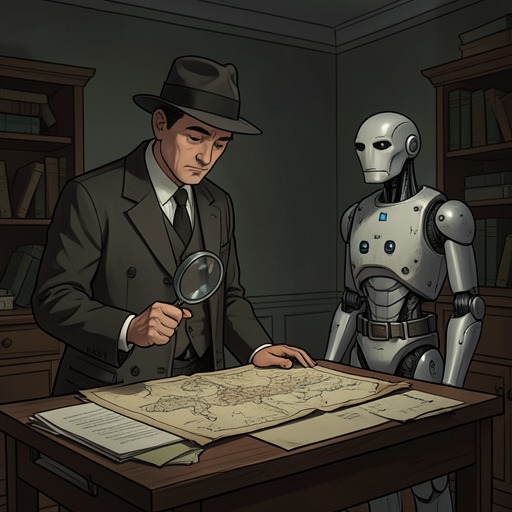
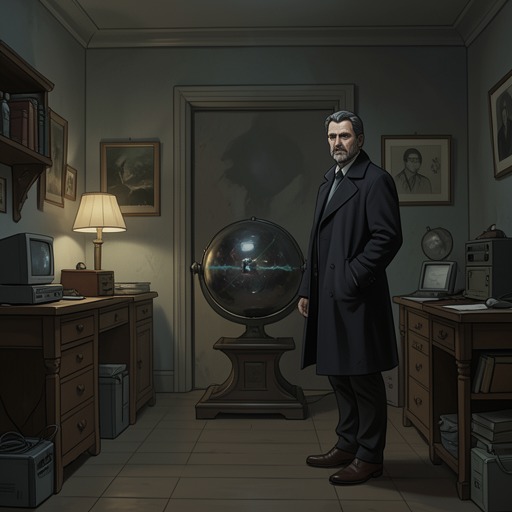
The Caves of SteelEnderby’s glasses, initially an everyday aid for his nearsightedness, become the decisive physical clue in the solution to Dr. Sarton’s murder. Their breakage at the dome accounts both for Enderby’s presence there earlier than he had claimed and for his inability, in a moment of tension, to distinguish Dr. Sarton from R. Daneel, whom Sarton had designed in his own image.
Identity and Role in the Case
Enderby’s glasses matter because they connect a personal physical limitation to a precise sequence of events. Elijah Baley realizes that the Commissioner’s nearsightedness and spectacles are not incidental details: the lenses had broken in Spacetown, and the circumstances of that break explain why Enderby could have mistaken the person who emerged at the dome’s door. The glasses therefore help turn a seemingly inexplicable killing by a man Baley believes is not a killer into an accidental misidentification supported by material evidence.
The clue emerges late in Baley’s reasoning. He tells R. Daneel that he had not found a way past the assumption that the Commissioner was not a killer until he recalled mentioning Daneel’s former curiosity about Bentley’s contact lenses. That recollection directs him toward Enderby’s own glasses. Baley also notes that nearsightedness is apparently absent on the Outer Worlds, suggesting that this physical difference had made the clue less obvious to the investigators from there.
Breakage and the Mistaken Identification
Enderby had earlier told Baley that he broke his glasses in Spacetown. Baley had assumed the break occurred because Enderby was agitated on hearing about the murder, but recognizes that this was an assumption rather than something Enderby had actually said. If Enderby entered Spacetown already intending a crime, Baley reasons, he could have been agitated enough to drop the glasses before the murder took place. That distinction changes the timing of the break and places Enderby at the dome earlier than investigators had believed.
Baley reconstructs the moment at the dome through Enderby’s known nervous habit: when nervous, he removes his glasses and wipes them. His hands were shaking; he dropped the spectacles, perhaps stepped on them, and broke them. At that point the door opened, and a figure resembling R. Daneel faced him. Without the glasses, Enderby could not distinguish Daneel from Dr. Sarton. He fired at the figure, gathered the broken remains, and left; the person he had killed was Sarton, who had designed Daneel in his own image.
Fragments as Proof
The reconstruction is not left as inference alone. Baley points to a sparkle in the grooves of the dome’s open door. R. Daneel identifies the material as two small slivers of glass, which had previously seemed to mean nothing. Baley recognizes them as pieces of concave lenses and proposes comparing their optical properties with those of the glasses Enderby is wearing.
The spectacles themselves are at risk of being destroyed when Baley warns Enderby not to smash them. He lunges and wrenches them from the Commissioner’s hand, then holds them out for R. Daneel. The broken slivers in the door grooves and Enderby’s intact spectacles can now be tested against one another. Together, they establish that the glasses were broken at the dome and support Baley’s conclusion that Enderby was there earlier than previously supposed.
Significance
The glasses change from a routine personal object into evidence when they are broken, misplaced, and finally examined as material things. Their absence does not merely impair Enderby’s sight: it creates the conditions for his fatal error, while the fragments left behind preserve a trace of the act he tried to conceal. The same object thus explains both the mistaken identity and the route by which the truth can be demonstrated.
Their role also depends on the difference between an assumed detail and an established fact. Baley had initially supplied a motive for the breakage—agitation upon hearing of the murder—that Enderby had never confirmed. Revisiting that assumption allows him to shift the break to an earlier moment, connect it to Enderby’s presence at the dome, and recognize why the murder could have occurred without making the Commissioner a deliberate killer. The glasses do not by themselves explain every part of the case; their force lies in joining Enderby’s nearsightedness, his nervous gesture, the glass in the door grooves, and the likeness between Sarton and Daneel into one evidence-backed account.